The Laman Family Coat of Arms
⚜️ The Blazon
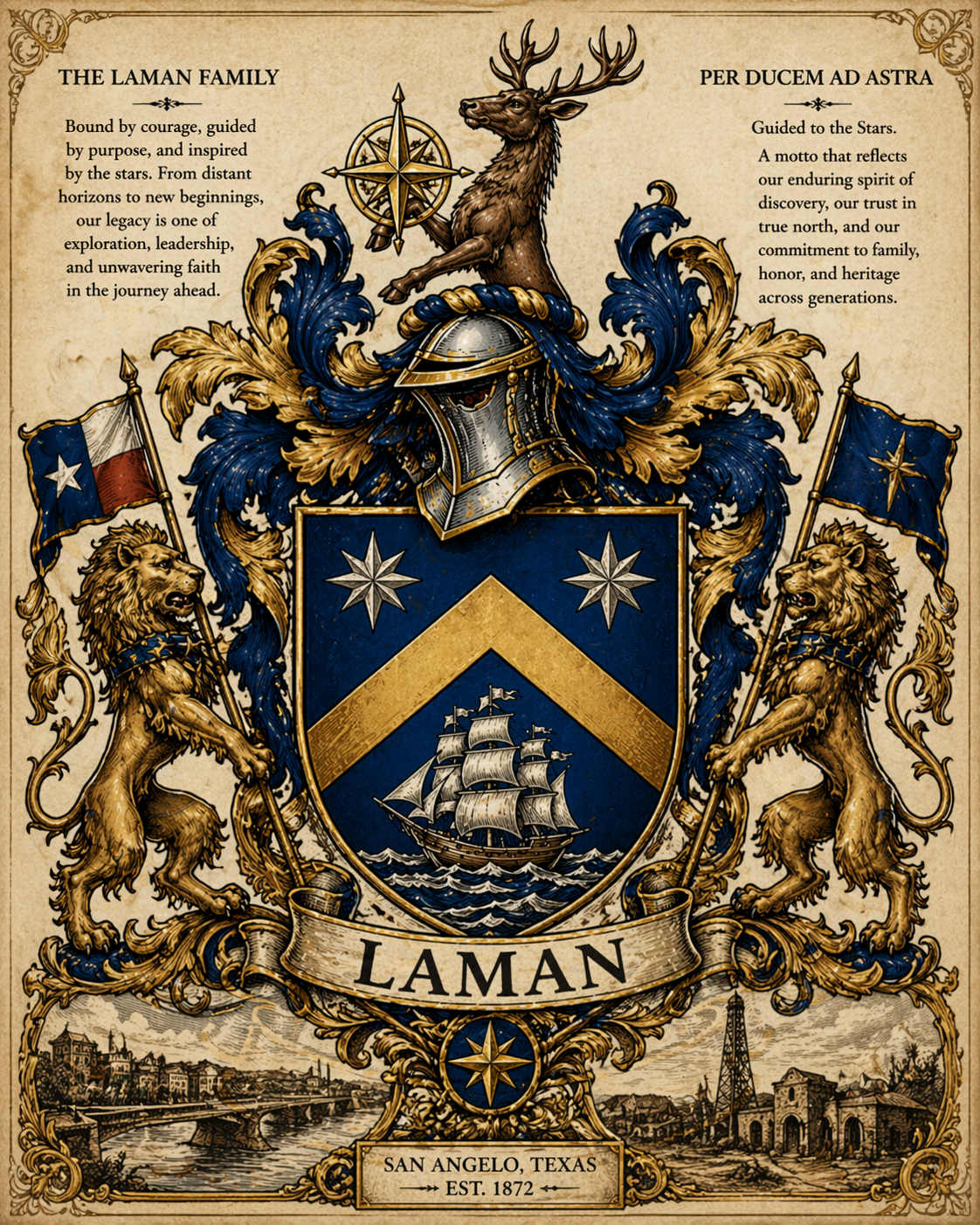
Azure, a chevron Or between in chief two mullets argent and in base a ship under sail proper.
🦁 The Crest
A stag trippant proper supporting a compass rose Or.
The Meaning Behind the Symbols
Represents loyalty, truth, and steadfastness
Symbolize guidance, aspiration, and the pursuit of higher ideals
Represents journey, exploration, perseverance, and crossing great distances
The stag symbolizes peace, harmony, and noble bearing; the compass represents direction and purpose
The Laman Family Story
A Heritage of Guidance and Resilience
The Laman coat of arms presented here reflects a design rooted in traditional European heraldry, combining symbols of guidance, ambition, and enduring legacy. While coats of arms were historically granted to individuals rather than entire families, this composition draws upon established heraldic motifs to create a meaningful representation of the Laman name.
The shield is set in deep blue (azure), a color long associated with loyalty, truth, and steadfastness. Across it runs a prominent golden chevron, a classic heraldic symbol representing protection and the building of lasting foundations - often associated with those who have achieved distinction through service or enterprise. Flanking the upper field are two silver stars, emblematic of guidance, aspiration, and the pursuit of higher ideals.
In the lower portion of the shield, a fully rigged ship sails upon stylized waves. The ship is a powerful emblem of journey, exploration, and perseverance, often used to represent those who have crossed great distances or forged new paths. It speaks to movement across generations - whether through migration, ambition, or the steady passage of time.
Above the helm, the crest features a stag holding a compass rose. The stag, a symbol of peace, harmony, and noble bearing, is often associated with wisdom gained through experience. The compass reinforces themes of direction and purpose, suggesting a lineage guided by principle and clarity even in uncertain times.
Together, the Laman arms form a cohesive and elegant design - one that reflects a heritage shaped by guidance, resilience, and the courage to navigate new horizons.
The Laman Family Journey
Hello and Welcome to the Laman Family Tree Project. This project started, at least from this standpoint, about 35 years ago with my Uncle Burl Dean Laman. I went to stay with him for a weekend when I was just turning 18, and he showed me his research. He had about 50 pages of information written on Family Data sheets, and I was able to sit and read through it. That is the day the genealogy bug hit me. I asked if I could help with the project, and he gave it to me.
Back then, doing research was a demanding task. It was before the internet became a tool. If you wanted to research, you had to go to a physical library, and hope they had some sort of research section. You had to dig through files, books, and research papers. But I had no problem with any of that. Eventually the internet started becoming useful. America Online made it possible to reach out and talk to other researchers. The digital age of information had begun, and museums and research facilities were starting to digitize more and more.
When I learned that George Allen Laman was born in New Mexico, I had to reach out to someone near there and get a photo of the headstone to see if it matched my information. But eventually Find-A-Grave was created and genealogists from around the world joined in and it became a network of researchers working together. But none of that discouraged me. I began growing the tree, only putting in information that I was able to verify. Keeping unverified information separate, and deleting unproven information all together.
There are so many Laman trees that have so much inaccurate information, because so many researchers decide to plug in other trees without verifying the roots, just so it made their tree look fuller. Other researchers I have come across have omitted information just because they didn't like what the research said. I refuse to do that. Every family tree has branches that don't quite fit the standard structure. Ours is no different. Ancestry and FamilyTree, and many other standard sites were there when I got started, but after a while I realized that they did not shift or sway to make the tree reveal the true structure of today's family. So instead of fighting the standards, I sat down and developed my own database that provided the information I needed. It was long, sometimes messy, and definitely unconventional, but I finally had the genealogy database I needed to tell the true story. So back to research I went.
During my journey I came across many interesting characters, and I have learned so much from them. One of the most influential characters I came across was Earl R. Layman, the writer of "A Lehman, Layman Genealogy Handbook." This was quite the read, and that is where I learned about the Layman Family DNA project. In his research he gathered DNA from any member of the family that would submit it. That is where our little tree gets interesting.
In my research, we have only been able to find and verify the tree up to George Allen Laman (b. 1795). Unfortunately, this is where our tree has been stalled for years. But during Earl's DNA project, one of our ancestors' descendants from Roy Carl Laman (#344) participated in the project and the results came back a match. But here is the kicker. When the DNA tests were done for this project in 2005, they only used 10 markers. While early genealogical DNA tests in the mid-2000s utilized a small number of markers (around 10–25 STRs), modern autosomal DNA tests for genealogy now examine 700,000 to over 600,000 SNPs (Single Nucleotide Polymorphisms). These high-density arrays allow for precise matching with distant relatives and detailed ancestry breakdowns. So, at the time, although we could match our Laman tree with Earl's Layman tree without a doubt, we could not find the missing link. There is only about 1 or 2 generations missing, and there are several theories, but none have been proven as of yet.
So, what does this mean? Well, what we know with certainty is that our "Trunk" George Allen Laman (b. 1795) is in fact related to Earl Layman's "Trunk" Peter Leman born in the Emmental of Canton Bern, Switzerland. I know what you are thinking, but wait, the Laman's are German. Well, to an extent, you are correct. By using DNA to verify that we are in fact related to Peter Leman, and through Earl's and many other's research, we now know how our family first came to step foot in the Americas.
To keep it short for now, this story basically starts during the 30 Years War which began in 1618. During that war many families fled to safety, to an area that became Switzerland. Therefore, as a result of much research and DNA testing, many branches of the Laman tree who always believed they were of German descent, are now learning that their ancestors were, in fact, German-speaking Swiss. The Lamans (multiple spellings) at that time were Mennonites and did not believe in taking up arms. That became a problem in 1691 when it was decreed that anyone refusing to swear allegiance and take up arms were no longer tolerated, and another wave of persecution began.
Thankfully, around 1708 and 1709, Queen Anne took advantage of the situation and offered the Palatines a way out. Books were dispersed throughout the Palatine with her image on the front, known as the Golden Book because the letters on the front were written in gold colored ink. Its purpose was to encourage the Palatines to come to England in order to be sent to settle in Her Majesty's colonies in North America.
In August 1717, three ships arrived in Philadelphia with a total of 363 immigrants, most if not all of whom were Swiss Mennonites from the Swiss Emmental. Their destination was Chester County (later Lancaster County), Pennsylvania. In the History of Lancaster County by Ellis & Evans, p. 359, a letter is copied. James Steel, Surveyor General in Philadelphia, wrote it on 27 September 1717 to his friend Isaac Taylor. A portion thereof reads as follows:
"John Funk and Christian Herr applied yesterday on behalf of their countrymen that are lately arrived for several parcels of land near their settlements, but before I have the consent of the Commissioners Warranty ready, being just taking horse for Duck Creek, however they design of being upon surveying thereabouts in so little time as thou mentioned when here: Thou may lay out for the following several tracts of land under mentioned."
In the list was:
"For Peter Leman and Henry Funk 5 or 600 acres."
It also goes on to say the following:
"Thou need not insist on these men's bonds because they are to pay down their money without delay."
This would lead us to believe that these men brought with them a reputation for being men of substance and integrity. It also raises the question of how Peter Leman acquired at least a moderate amount of wealth.
Another point of distinction worthy of mention here is that at the time of immigration during this period, the German-speaking immigrants were referred to as Palatinians. Another title bestowed upon them was "Pennsylvania Dutch." As we now know, the term "Pennsylvania Dutch" refers not to Dutch but rather a corruption of the German word "Deutsch" which means "German." Therefore, it is safe to say that as far as the Laman descendants are concerned, evidence now supports that the term "Pennsylvania Dutch" might more accurately be termed "Pennsylvania Deutsch-speaking Swiss."
There are many more stories and documents of Peter Leman and his land dealings, but until we can make the full link, I will save those for another time.
There are many interesting stories to share with you, and lots of research still to be added, so I leave you with this: A tree is only as strong as its roots, and those roots must forever be protected and handed down to ensure the tree survives. Just as my uncle Burl passed his research down to me, I too am sharing my research with my daughter Sailor, who will continue the journey.
I tried to design this website less like a genealogy website, and more like a journey into a beautiful heritage. I hope you like what I have done, and know that information is constantly being added, and your input and comments are always welcome.
May your journey be as beautiful as you are.
Skipper Laman
Our Family Today
While honoring the traditional Laman coat of arms, our family continues to write its own story. Each new generation adds its own chapter, carrying forward the values of courage, honor, and faith that have defined the Laman name for centuries.
Family crest designed by Alan Laman Jr. for the Laman Family Tree genealogy project, honoring our heritage and celebrating our future. Copyright 2026